Feeling Blewe
The latest headlines got you feeling blue? Well, I’ve got a very small bit of good news. It’s astronomical, political, etymological and cultural. Ready?
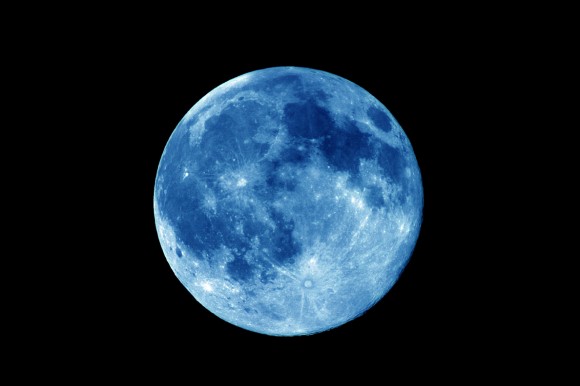
You may recall from a previous post the tortured history of what today we call a “Blue Moon,” and it involves at least two definitions of that phrase. The first is the middle English word “blewe”, which is pronounced like “blue” and means “betrayer.” Evidence of it comes from a medieval pamphlet written by two English friars attacking the Catholic church and the pope’s oversight of the calendar, in which they wrote, ““Yf they say the mone is blewe, we must believe that it is true.” Specifically, in the Roman calendar, whenever a quarter contains 4 full moons, the 3rd of them is considered the oddball, the betrayer, the “blewe” one.
This definition survived into the 20th century. But then, an article in Sky and Telescope magazine incorrectly explained that a Blue Moon was any second full moon in any given month. This definition made its way into the first printing of Trivial Pursuit, and was so widely disseminated that it became today’s standard.
But before that happened, an island in Indonesia erupted. In 1883, a volcano called Krakatoa spewed so much volcanic ash into the atmosphere that for over a year the full moon appeared around the world in all sorts of funky unnatural colors. Some folks believe this event was so shocking that it is the source of the modern phrase “Blue Moon.”
Skip to 1934, when songwriters Rodgers and Hart released “Blue Moon,” a song so powerful that it erupted on the pop charts as the #1 tune of that year, was a hit twice more in 1949, and topped the doo-wop charts as late as 1961. It’s been recorded by everyone from Sinatra to Rod Stewart, Dino to Dylan. It’s become such a standard that regardless of whether the title means “Betrayer” or “Funky Color”, today a “Blue Moon” is synonymous with a moment of complete melancholia.
Which is unfortunate, considering that this Sunday, May 31, at 4:45 AM Eastern, we’ll have the second full moon of the month. You may wake up feeling a little Blue.
But here’s the good news. When the Moon orbits the Earth, it doesn’t go around in a circle. It travels in an ellipse, which brings it as close to us as 363 thousand kilometers away (that’s called the “Perigee”), and as far away from us as 405 thousand kilometers (the “Apogee”). That’s a large distance, and that makes a big difference.
A full moon at Perigee can appear much larger and brighter than on average, so much so that we call that a Supermoon. And a full moon at Apogee is the opposite, it can appear about 15% smaller, and almost 30% dimmer, than a Supermoon.
This weekend there will be a Blue Moon. Bummer. But the good news is that it will occur with the moon very far away, at its Apogee. Which means your melancholy moment will be minimized. You may be standing alone, without a dream in your heart, without a love of your own. But at least you will be standing under what astronomers call…
…a Micromoon.